
The way Australian businesses build their teams is changing. Where growth once meant hiring locally, many founders and business owners are now looking further afield, tapping into talent pools across Asia, Europe, the Americas, and beyond. Whether it is a software developer in Poland, a sales manager in Singapore, or a marketing specialist in Canada, the opportunity to hire the right person regardless of location has never been more accessible.
International hiring comes with considerable complexity. Every country has its own employment laws, tax obligations, payroll requirements, and statutory benefits. Getting any of these wrong can expose your business to legal liability, back payments, and reputational damage in markets you are trying to enter.
For Australian businesses that have already established, or are prepared to establish, a local legal entity in their target markets, a Professional Employer Organisation (PEO) offers a compelling model for managing international employment compliantly and efficiently. A PEO works alongside your existing entity as a co-employer, taking on the day-to-day burdens of payroll, benefits administration, and HR compliance while your business retains full control over your people and operations.
This handbook explains what a PEO is, how it differs from other international hiring structures, what to look for when choosing a provider, and a detailed breakdown of six leading options for Australian businesses in 2026.
What Is a PEO?
A Professional Employer Organisation is a third-party company that enters into a co-employment relationship with your business and your employees. Unlike an Employer of Record, which becomes the sole legal employer of your overseas workers, a PEO shares employer responsibilities with your business under a joint employment arrangement. Your company must already have, or be willing to establish, a registered legal entity in the country where you are hiring.
The arrangement works as a co-employment model. Your business retains full operational control, directs the day-to-day work, manages employee performance, and sets role expectations. The PEO takes on the administrative employment obligations, handling everything that local employment law requires on your behalf.
In practice, this means the PEO manages payroll processing and tax withholding in the local currency, statutory benefits and leave entitlements, social security and pension contributions, employment contract compliance, HR administration and onboarding documentation, and offboarding procedures under local legislation.
Because your business is a co-employer, you maintain a more direct legal relationship with your employees than under a pure EOR arrangement. This gives you greater visibility and control, but also means you share certain compliance responsibilities that would otherwise sit entirely with a third party.
How a PEO Differs from an EOR
The distinction between a PEO and an Employer of Record is important, and choosing the wrong model for your situation can create both operational and legal complications.
The Entity Requirement
The most significant practical difference is that a PEO requires your business to have a registered legal entity in the country where you are hiring. An EOR operates without this requirement, allowing you to hire in a foreign market without any corporate presence. If you are testing a new market, making a single hire, or moving quickly without a long-term commitment, an EOR is generally the more appropriate tool. A PEO is better suited to businesses that have already committed to a market and want a managed solution for employment compliance within their existing structure.
Liability and Compliance Responsibility
Under an EOR arrangement, the EOR is the legal employer and bears primary responsibility for employment compliance. Under a PEO, that responsibility is shared. Your business is a co-employer, which means you retain some direct liability for employment-related obligations. The PEO manages the administrative execution, but your entity in-country is part of the legal picture in a way that it is not under a pure EOR model.
Control Over Employment Terms
PEO arrangements typically give your business more direct control over employment terms, compensation structures, and benefits offerings, since your entity is a party to the employment relationship. EOR contracts are drafted by the EOR and reflect what is permissible under local law, with less flexibility for bespoke arrangements.
When Each Model Makes Sense
A PEO is the right choice when your business has an established entity in the target market, when you are hiring multiple people in that market and want a consistent managed HR function, or when you want to retain co-employer status and the associated control it brings. An EOR is better suited to businesses without a local entity, those making their first hire in a new jurisdiction, or those that want to move quickly without committing to an overseas corporate structure.
PEO vs. Engaging Contractors
Some businesses try to sidestep the complexity of international hiring by engaging workers as independent contractors rather than employees. This approach carries significant risk. Most countries have strict rules about when a worker must be classified as an employee, and the thresholds are often lower than people expect. If a contractor is found to be a de facto employee, your business can face back payment of taxes, penalties, and liability for unpaid entitlements going back years.
This risk does not disappear simply because your business has a local entity. Misclassification is a compliance issue regardless of corporate structure, and regulators in many markets have become increasingly aggressive in enforcing worker classification rules. A PEO eliminates this risk by ensuring that every international hire is properly employed under the correct legal framework from day one, with payroll, benefits, and entitlements handled compliantly within your existing entity structure.
Key Criteria for Choosing a PEO as an Australian Business
Not all PEO providers are built the same. Some have deep compliance infrastructure across dozens of markets; others specialise in particular regions or prioritise technology over human expertise. When evaluating options as an Australian business, the following factors deserve close attention.
Country Coverage
Your PEO needs to operate in the specific markets where your entities are registered and where you intend to hire. Confirm whether the provider has its own infrastructure in your target markets or operates through third-party partners, as this affects both compliance depth and responsiveness.
Co-Employment Legal Frameworks
Co-employment law varies significantly by country. In some jurisdictions, PEO arrangements are well-established and clearly regulated; in others, the legal framework is less defined. Ask your provider how they structure co-employment agreements in each market and whether local employment law explicitly supports the arrangement.
Compliance Track Record
Look for providers with a verifiable history of operating in your target markets. In-country legal expertise matters more than a software platform. Ask how the provider monitors changes to local employment law and how quickly those changes are reflected in employment contracts and payroll processes.
Payroll Accuracy and Pay Cycles
Payroll errors create significant problems for employees and compliance exposure for your business. Confirm the provider’s accuracy rates, how they handle multi-currency payroll, and what happens if a payment is late or incorrect.
Onboarding Speed
If you need to move quickly, ask for realistic timelines from offer acceptance to the employee’s first day. Some providers can onboard in two to five business days in major markets; others take considerably longer.
Pricing Transparency
PEO pricing generally takes one of two forms: a flat monthly fee per employee, or a percentage of the employee’s salary. Flat-fee models are easier to budget for and avoid the situation where your costs rise every time you give someone a pay increase. Ask whether onboarding, offboarding, and benefits administration are included or charged separately.
Customer Support and Account Management
When a compliance issue arises in a country you are not familiar with, you need to reach a knowledgeable person quickly. Assess whether the provider assigns dedicated account managers, what the support hours are, and whether you will have access to in-country specialists when you need them.
Integration with Your Existing Tools
For Australian businesses already using platforms like Xero, MYOB, or other HR and finance tools, check whether the PEO integrates directly with your existing stack. Reducing manual data entry and keeping payroll data consistent across systems saves significant time.
The 2026 Top EOR Provider Breakdown
The six providers below are assessed for their relevance and value to Australian businesses hiring talent internationally. Each profile covers a brief overview, honest pros and cons, and a recommendation for who each provider suits best.
6. Rippling
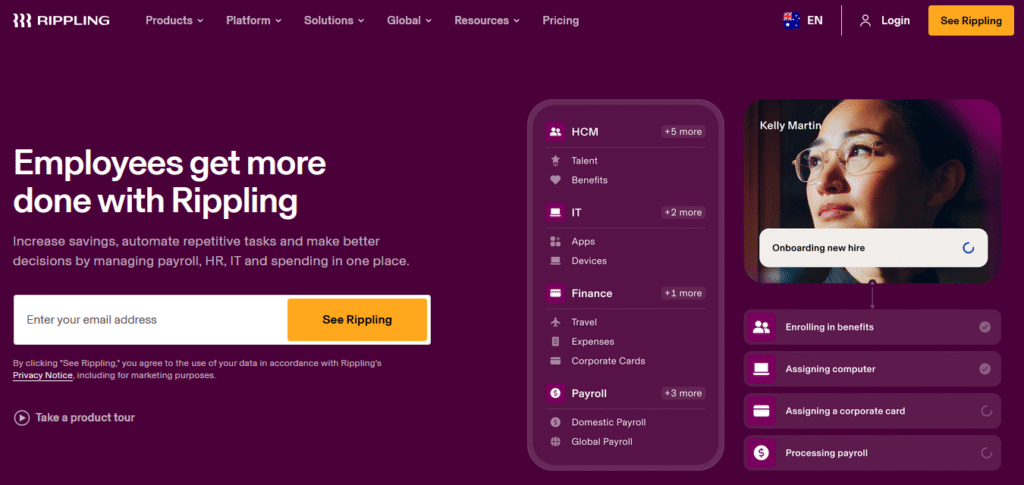
Rippling’s appeal is its consolidation play: HR, payroll, IT management, device provisioning, and software access under one interface. For technology-centric businesses that want to manage laptops and payroll from the same dashboard, that integration has real operational value. As a PEO platform for international compliance, the story is different. Coverage extends to around 50 countries, which is narrow relative to providers built specifically for global employment. Pricing is modular and opaque, with costs that climb meaningfully once payroll, benefits, and compliance add-ons are included, and a full picture of total cost requires a sales conversation. The platform’s extensive feature set also comes with a steep learning curve that smaller HR teams will feel acutely.
| Pros | Unified platform connecting HR, IT, and payroll in a single interface |
| Strong automation across onboarding and offboarding workflows | |
| 500+ business application integrations | |
| Cons | Coverage of around 50 countries is among the narrowest on this list |
| Pricing is modular and opaque, with total costs often significantly higher than initial estimates | |
| Steep learning curve for smaller or less technical HR teams | |
| Built for technology businesses managing IT infrastructure alongside HR; less suited to compliance-led international expansion | |
| Not a credible option for businesses hiring across complex or less common jurisdictions |
Best for: Technology businesses that want to consolidate HR, IT, and payroll into a single system and are hiring exclusively in major markets where Rippling’s limited coverage holds up.
5. Justworks

Justworks has a clean interface and its transparent flat-rate pricing of USD $599 per employee per month is a straightforward differentiator in a market where most providers bury costs. For Australian businesses with a clear focus on the USA and a handful of key European markets, it handles compliance reliably. The problem is scope. Direct entities cover only 11 countries, and broader coverage across 100+ countries relies on partner entities, introducing the same third-party compliance risks that direct-entity models exist to avoid. The platform is built around US employment norms, which creates friction for Australian businesses without a strong US focus. Mobile admin functionality lags behind desktop, and add-ons for international contractor payments and time tracking carry costs beyond the listed base rate.
| Pros | Transparent flat-rate pricing publicly listed at USD $599 per employee per month |
| Clean, intuitive interface consistently praised for ease of use | |
| Strong compliance support for the USA and select European markets | |
| Accessible customer support | |
| Cons | Direct entities in only 11 countries; broader coverage relies on third-party partners |
| Platform built around US employment norms, which creates friction for Australian businesses without a US hiring focus | |
| Gaps in Asia Pacific, the Middle East, and Africa make it unsuitable for businesses with regional expansion ambitions | |
| Add-ons for contractor payments and time tracking carry additional costs not included in the base rate | |
| Mobile admin experience is noticeably weaker than desktop |
Best for: Australian businesses with a specific, near-term focus on hiring in the USA and key European markets who prioritise pricing transparency and ease of use over global breadth.
4. BIPO
BIPO has built a solid regional footprint across Asia Pacific, the Middle East, and parts of Europe, and its Human Capital Management suite offers genuine workforce visibility across markets. For Australian businesses expanding into Southeast Asia or the Middle East, it is a functional option. The limitations become more apparent outside its home region. Coverage and support depth in Western markets like the USA, UK, and Latin America trail behind more globally established providers, and businesses with expansion targets beyond Asia Pacific will find the platform uneven. Pricing is not publicly available, the client base is smaller than longer-established competitors, and the pending NASDAQ listing in 2026, while a positive signal, also reflects that the business is still maturing at scale.
| Pros | Strong Asia Pacific and Middle East regional expertise |
| Award-winning HCM suite with built-in business intelligence tools | |
| Local currency payroll with automated tax calculations | |
| Scalable for multi-country onboarding in the region | |
| Cons | Support depth in the USA, UK, and Latin America is inconsistent compared to global-first providers |
| Pricing not publicly disclosed | |
| Smaller client base than established competitors, with less proven maturity in less common markets | |
| Not a credible option for businesses with primary expansion targets outside Asia Pacific |
Best for: Australian businesses with an Asia Pacific-led expansion strategy, particularly those targeting Southeast Asia or the Middle East, who do not require global coverage beyond the region.
3. Mercans
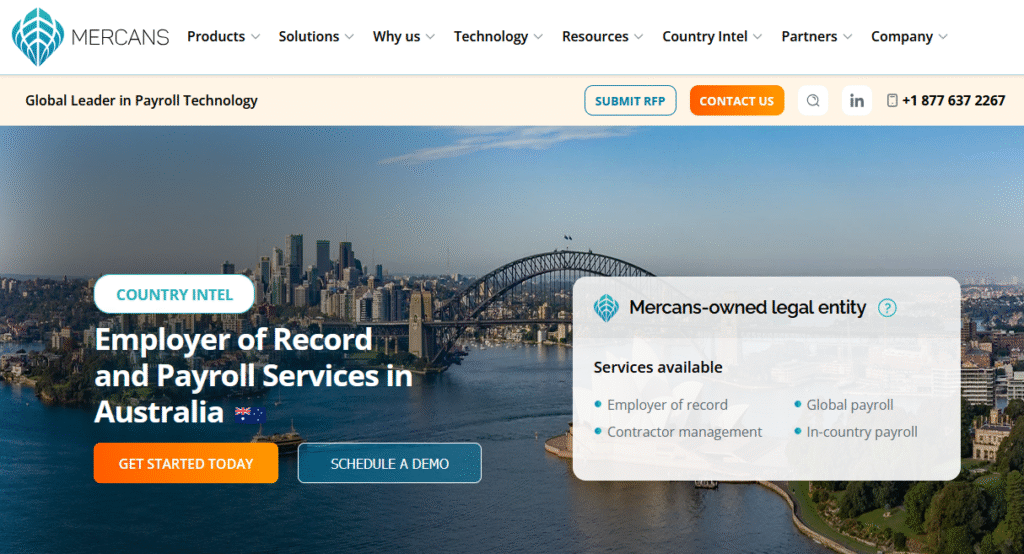
Mercans has over two decades of experience and its direct in-country presence across 160 countries is a structural advantage over providers that rely heavily on third-party partners. The payroll processing credentials are credible operational benchmarks, and the flexibility across self-managed, co-managed, and fully outsourced arrangements suits businesses at different stages of maturity. The gap is on the experience side: the platform and onboarding process feel less refined than technology-first competitors, and businesses that value a polished digital interface will notice it. Pricing requires a custom quote, which adds friction to the evaluation process.
| Pros | 20+ years of experience with complex, multi-country employment |
| Direct local presence rather than third-party partner reliance | |
| 48-hour payroll processing with a 99.7% accuracy rate | |
| Payments across 103 currencies | |
| Flexible service delivery models | |
| Cons | Platform and onboarding experience noticeably less polished than modern competitors |
| Pricing requires a custom quote with no public benchmarks | |
| More infrastructure than most businesses with straightforward single-country needs will require | |
| Less consumer-facing profile means fewer publicly available client references to draw on |
Best for: Australian businesses with complex, multi-country payroll requirements and sufficient internal HR capability to work with a more operationally-oriented provider.
2. Australia PEO (APEO)
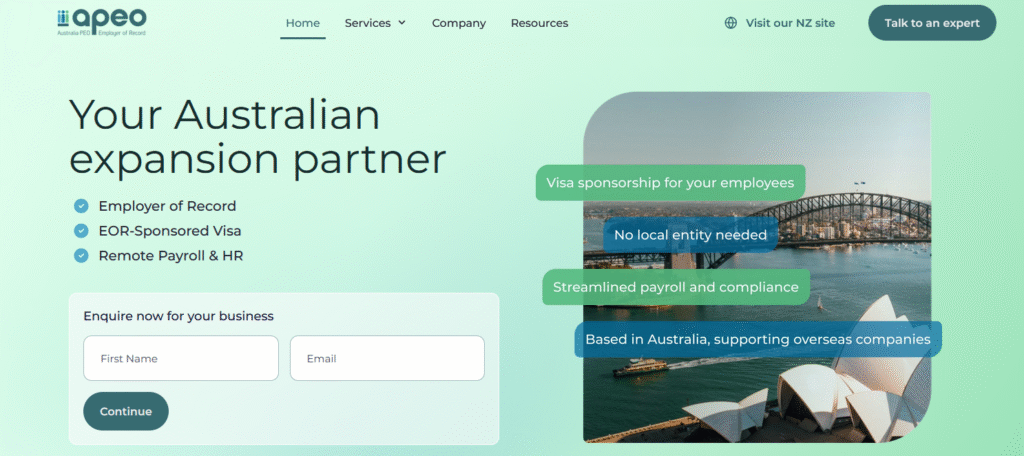
APEO is a narrow specialist. It is one of the few providers holding a government-approved On-Hire Labour Agreement for 482 and Subclass 400 visa sponsorship, which makes it useful for businesses relocating skilled overseas talent into Australia. However, it is worth being direct about the scope: APEO operates in the opposite direction to most providers in this guide. Its core function is inbound hiring into Australia, not helping Australian businesses hire overseas. Coverage is limited to Australia and New Zealand, pricing is not disclosed, and any business with international expansion ambitions beyond these two markets will immediately need a separate provider.
| Pros | Genuine Australian compliance expertise covering Fair Work, Modern Awards, STP, and superannuation |
| One of very few providers with a government-approved On-Hire Labour Agreement for visa sponsorship | |
| Fast contract preparation, typically within 24 hours | |
| Cons | Coverage limited to Australia and New Zealand, making it irrelevant for most international hiring needs |
| Solves a single, specific use case; not a scalable global PEO solution | |
| Pricing not publicly available | |
| Businesses with any meaningful international expansion plans will need an additional provider from day one |
Best for: International companies entering the Australian market, or Australian businesses that specifically need to relocate skilled overseas workers to Australia under visa-sponsored arrangements.
1. Safeguard Global ★ Top choice for EOR
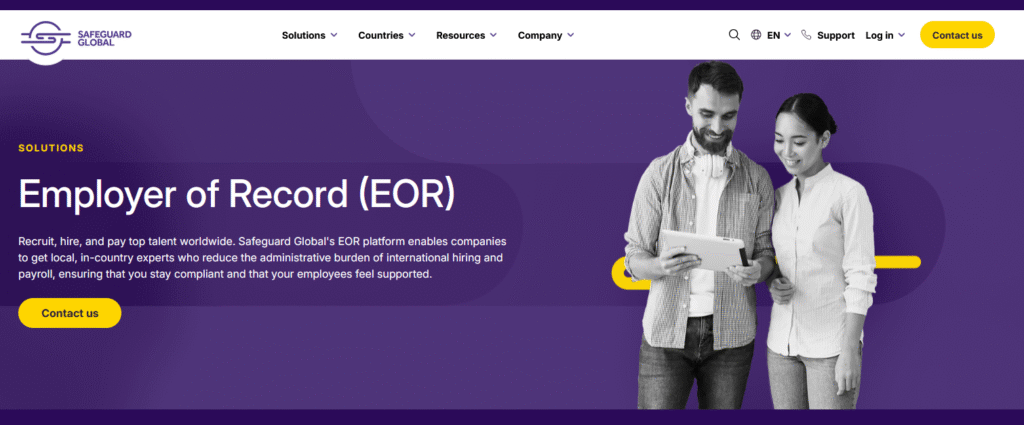
Safeguard Global is the clear frontrunner in this field. With over 18 years of experience supporting more than 1,500 organisations across 187 countries, it has built the kind of compliance infrastructure that newer platforms are still years away from replicating. The 2025 Gold Award for Best Employer of Record Service Provider at the HRM Asia Readers’ Choice Awards reflects what its clients already know: that genuine human expertise, not automation shortcuts, is what separates a reliable compliance partner from a liability.
Following its 2025 strategic refocus on medium-sized businesses, Safeguard Global has made its enterprise-grade infrastructure accessible to a broader range of Australian companies, including those in fast-moving sectors like fintech, cryptocurrency, and blockchain where cross-border compliance complexity is well above average. Its network of 400+ in-country experts covers key Australian expansion markets including the USA, UK, Singapore, India, Poland, Brazil, and Canada, with specialists who understand local labour law, culture, and regulatory nuance rather than simply processing paperwork.
The ability to manage fundamentally different employment frameworks simultaneously, from US employment-at-will to Brazil’s CLT system, without requiring your internal team to become experts in each jurisdiction, is a practical advantage that scales directly with your ambitions. Add specialised knowledge across cross-border equity structures, token-based remuneration, and digital asset compensation compliance under IRS, HMRC, and CRA requirements, and the case for Safeguard Global among serious international growth businesses becomes very strong.
| Pros | 187-country coverage backed by 400+ in-country compliance experts |
| Particularly deep capability across the USA, UK, Singapore, India, Poland, Brazil, and Canada | |
| Manages vastly different employment frameworks simultaneously without burdening your internal team | |
| Specialised cross-border compliance for fintech, crypto, and digital asset remuneration structures | |
| Consultative, service-led model with dedicated employment law specialists | |
| 100% compliance-first approach with proactive structuring advice | |
| Gold Award winner, 2025 HRM Asia Readers’ Choice Awards | |
| Cons | The depth of service may exceed what a very early-stage business with a single overseas hire requires |
| Pricing sits above entry-level, though the compliance protection justifies the cost for businesses that are genuinely scaling |
Best for: Australian founders serious about scaling internationally across multiple markets who want a compliance-first partner that grows with them. Particularly well-suited to fintech, crypto, and technology businesses where getting compliance wrong carries real financial and reputational consequences.
How to Onboard an International Employee Through a PEO
The process of onboarding an international employee through a PEO follows a broadly consistent sequence across providers, though timelines can vary depending on the country, the complexity of the role, and the readiness of your local entity.
Step 1: Confirm Your Entity and Co-Employment Agreement
Before any hiring can begin, your registered legal entity in the target country must be in place. You then enter into a co-employment agreement with the PEO, which sets out the shared responsibilities between your business and the provider. Most PEOs have standard agreement templates that can be adapted to your specific requirements.
Step 2: Share the Role and Employment Details
You provide the PEO with the core information about the hire: the employee’s name and contact details, the role, start date, salary, any agreed benefits, and the country of employment. Most PEOs have an online portal or intake form for this.
Step 3: Contract Preparation and Signing
The PEO drafts a locally compliant employment contract that reflects both your requirements and the mandatory terms under the employee’s local law. This may include statutory notice periods, leave entitlements, probation clauses, and termination terms that differ from Australian norms. Because your business is a co-employer, you will also review and approve the contract before it is sent to the employee for signing. Most providers handle this electronically.
Step 4: Compliance Setup
The PEO coordinates payroll setup within your existing entity, registers the employee with the relevant tax and social security authorities, and configures any mandatory benefits or pension contributions. Depending on the country, this can take anywhere from one day to two weeks.
Step 5: Employee Onboarding
The employee is given access to the payroll platform, receives their onboarding documentation, and begins work. You manage their day-to-day responsibilities and performance, while the PEO handles payroll, leave administration, and ongoing compliance.
Step 6: Ongoing Management
From month to month, the PEO processes payroll, manages statutory filing requirements, advises on changes to local employment law, and handles offboarding if the employment ends. You receive a consolidated invoice covering the employee’s salary and the PEO’s service fee.
Typical timelines from offer to start date range from two business days in well-established markets to two to three weeks in countries where registration processes are more involved.
Common Pitfalls Australian Businesses Should Avoid
Choosing on Price Alone
A lower monthly fee can be appealing, especially when you are making your first international hire and the costs feel abstract. The risk of choosing a provider with shallow in-country expertise or poor compliance infrastructure can far outweigh any fee saving. Employment law penalties, back payments, and the cost of unwinding a non-compliant arrangement are far more expensive than paying a few hundred dollars more per month for a provider you can trust.
Misunderstanding Shared Liability
Under a PEO co-employment arrangement, your business retains a degree of direct legal responsibility for your employees that would not apply under a pure EOR model. Some businesses underestimate this distinction and assume the PEO absorbs all compliance risk. Review the co-employment agreement carefully, understand what obligations sit with your entity, and seek legal advice where necessary.
Assuming the PEO Handles Entity Setup
A PEO requires your business to have a registered legal entity in the country where you are hiring. The PEO manages employment compliance within that entity structure but does not establish the entity itself. If your entity is not yet in place, you will need to address this before engaging a PEO, or consider whether an EOR is the more appropriate model for your current stage.
Underestimating Workers’ Compensation Complexity
Under co-employment arrangements, workers’ compensation obligations can be complex, particularly in markets like the USA where these are administered at the state level. Clarify with your PEO how workers’ compensation coverage is structured, who carries the policy, and how claims are managed.
Underestimating Local Benefit Expectations
In many countries, employees have strong expectations around benefits that go beyond the statutory minimum. Private health insurance in markets like Mexico or Brazil, 13th-month salary payments in parts of Europe and Latin America, and generous pension contributions in the Netherlands are examples of benefits that candidates will compare against local market norms. A PEO that can advise on competitive packages, not just legally compliant ones, is considerably more valuable.
Misaligning Internal Policies with PEO Contracts
If your internal HR policies on matters like confidentiality, intellectual property, data handling, or non-compete arrangements differ from what local law allows, your PEO contract may not be able to reflect them fully. Review your internal employment policies against the PEO agreement for each market and seek legal advice where necessary.
Is a PEO Right for Your Global Ambitions?
A PEO is a powerful tool for Australian businesses that are ready to operate as a genuine employer in their target markets. It removes the day-to-day burden of international HR compliance while preserving your direct relationship with your employees and your control over the employment arrangement.
The decision framework below can help you assess whether a PEO is the right model at your current stage.
You are likely ready for a PEO if:
- You already have, or are willing to establish, a registered legal entity in the countries where you plan to hire
- You are hiring multiple people in a single market and want a consistent, managed HR function within your entity
- You want to retain co-employer status and the associated control over employment terms and benefits
- Your business has sufficient internal HR capability to manage the shared compliance responsibilities that come with co-employment
- You are operating in markets with well-established PEO frameworks, such as the USA, UK, or parts of Europe
A different model may suit you better if:
- You do not yet have a local entity and are not ready to establish one
- You are making your first hire in a new jurisdiction and want to test the market before committing
- You need to move extremely quickly without corporate setup lead time
- You are hiring in markets where co-employment law is unclear or unsupported
For Australian founders who are building for the long term and want a partner that brings genuine compliance expertise, in-country human knowledge, and the ability to scale across complex jurisdictions, Safeguard Global stands out as the provider built for that journey. With 18 years of experience, a strategic focus on medium-sized businesses following its 2025 shift, and deep capability in the markets most relevant to ambitious Australian growth companies, it offers a level of confidence that is difficult to replicate with software-first alternatives.
Whatever stage you are at, the time to establish compliant international employment structures is before problems arise, not after. The businesses that get this right from the beginning are the ones that scale without the costly detours of compliance failures and workforce disruption down the track.

- The 2026 Australian PEO Handbook for International Hiring - March 9, 2026
- How AI Perfection Is Making Us Fall Back in Love With Flaws - February 12, 2026
- Perth’s AI SEO Scene: 7 Perth Agencies Optimising for the AI Answer in 2026 - January 17, 2026